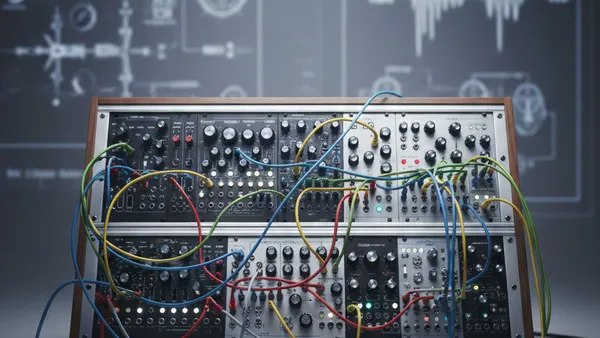
Ready to push your Eurorack beyond basic patches into pure generative chaos?
Prompted by NerdSip Explorer #9682
Master advanced CV logic, feedback, and generative techniques.
Advanced patchers know that raw modulation is rarely perfect. Enter the attenuverter and the offset—the unsung heroes of modular synthesis. While an attenuator only reduces a signal, an attenuverter can invert its polarity, flipping a rising envelope into a ducking envelope.
But the real magic happens when you combine this with DC offsets. By adding a constant voltage offset to a bipolar LFO (like a sine wave), you shift its center point. This allows you to scale and bias a -5V to +5V signal into a strictly 0V to +5V range, perfect for inputs that only accept unipolar control voltage (CV).
Mastering these utility modules means you stop reacting to your modulation and start commanding it. You can precisely dial in "how much" and "in what direction" a parameter moves, allowing for micro-modulations that breathe life into static patches rather than creating chaotic, sweeping messes.
Key Takeaway
Attenuverters and offsets allow you to precisely scale, bias, and invert CV for targeted micro-modulation.
Test Your Knowledge
Why would you combine a DC offset with an attenuverter?
When you push an LFO past 20 Hz, it crosses the threshold of human hearing and enters the audio-rate domain. Suddenly, you aren't just modulating a parameter; you are synthesizing entirely new timbres. This is the foundation of Frequency Modulation (FM) and Amplitude Modulation (AM).
In modular, you must choose between Linear and Exponential FM. Exponential FM alters pitch in a musically scaled way (1V/Octave) but drastically shifts the fundamental frequency when modulated at audio rates, creating chaotic dissonance. Linear FM, however, preserves the fundamental pitch while adding rich sideband harmonics, making it ideal for classic FM synthesis.
Similarly, manipulating volume at audio rates yields AM. If you use a bipolar carrier and modulator through a true ring modulator (which requires AC-coupled inputs), the original frequencies disappear entirely, leaving only the sum and difference frequencies. This is the secret to metallic, bell-like tones.
Key Takeaway
Audio-rate modulation creates new timbres via sidebands; Linear FM preserves pitch, while Exponential FM creates dissonance.
Test Your Knowledge
What happens when you use Linear FM at audio rates?
Traditional East Coast synthesis relies on subtractive methods: starting with a harmonically rich waveform and filtering it down. West Coast synthesis, pioneered by Don Buchla, flips this paradigm on its head by starting simple and adding complexity.
The core of this philosophy is the Complex Oscillator and the Wavefolder. Instead of a filter, a wavefolder takes a basic sine or triangle wave and folds it back in on itself when it reaches a voltage threshold. This generates dense, metallic harmonics that dynamically shift as the input amplitude changes.
To control this harmonically rich signal, West Coast patches use a Low Pass Gate (LPG) rather than a traditional VCA and Envelope. Often built with vactrols (LED-photoresistor components), LPGs impart a natural, non-linear decay that simultaneously reduces volume and high frequencies. This creates the signature organic, "plucky" bongo and marimba sounds synonymous with the West Coast style.
Key Takeaway
West Coast synthesis relies on adding harmonics via wavefolding and shaping notes with organic Low Pass Gates.
Test Your Knowledge
How does a Low Pass Gate (LPG) differ from a traditional VCA?
If you want to break free from rigid, repeating 16-step sequences, Boolean logic is your best friend. Logic modules take two or more gate or trigger signals and apply mathematical conditions to output entirely new rhythms.
An AND gate only fires if both Input A *and* Input B are high. Patching two different clock divisions here yields a sparse, syncopated trigger. Conversely, an OR gate fires if *either* A or B is high, creating a dense rhythm by merging two patterns into one.
The most musical logic gate is often the XOR (Exclusive OR). It outputs a gate if A or B is high, but *not* both. This is phenomenal for generating complex, shifting off-beats from two simple clock sources. By feeding these logic outputs into pinged filters or drum modules, you can derive endlessly evolving polyrhythms from a static clock setup.
Key Takeaway
Boolean logic modules (AND, OR, XOR) compare incoming gates to generate complex, shifting polyrhythms.
Test Your Knowledge
Which logic gate outputs a signal only if Input A OR Input B is high, but NOT both?
Generative music requires a delicate balance between chaos and repetition. Analog Shift Registers (ASRs) and Turing Machines provide the perfect framework for this, allowing you to create evolving melodies that still feel deeply musical.
An ASR takes an incoming CV value and, upon receiving a clock pulse, passes it to the first output. On the next pulse, that value shifts to the second output, while a new value enters the first. Patching these outputs to multiple oscillators creates beautiful, cascading canons and delayed harmonic structures.
The Turing Machine expands on this by combining a shift register with a noise source and a probability control. When probability is set to 0%, the sequence loops perfectly. At 100%, it introduces completely random new notes on every step. By dialing the probability to 5%, you create a sequence that mostly loops but occasionally mutates, mimicking the natural variation of a human performer.
Key Takeaway
Turing Machines and ASRs balance repetition and randomness, enabling evolving, generative melodic sequences.
Test Your Knowledge
What happens when a Turing Machine's probability parameter is set to 5%?
In the sterile environment of a DAW, routing an output back into an input often causes a hard crash or an ear-piercing squeal. In the hardware modular ecosystem, feedback loops are the gateway to organic, unpredictable sound design and chaotic systems.
By patching the output of a filter, delay, or VCA back into its own CV input (or an earlier stage of the signal path), you force the system to react to itself. This can transform a basic filter into a howling, chaotic oscillator that responds non-linearly to incoming triggers.
The key to taming this chaos is using VCAs within the feedback path. By controlling the feedback amplitude with an envelope or LFO, you can dynamically "play" the instability, allowing the patch to tear itself apart and cleanly snap back together in rhythm. This technique is vital for harsh noise, industrial soundscapes, and unpredictable ambient textures.
Key Takeaway
Routing signals back into their own CV inputs creates organic chaos, which can be rhythmically tamed using VCAs.
Test Your Knowledge
What is a key technique for taming chaotic feedback loops in a modular patch?
You don't need a dedicated physical modeling module to synthesize the sound of a plucked guitar string or a struck vibraphone. You just need a short delay, a noise burst, and a fundamental understanding of Karplus-Strong synthesis.
The patch starts with an "exciter"—typically a very short burst of white noise shaped by a snappy, instantaneous envelope. This burst is fed into a "resonator," which is a delay module set to extremely short times (audio-rate, often under 20 milliseconds) with the feedback turned up high.
The magic happens because the short delay time dictates the pitch of the resulting tone. By sending 1V/Octave pitch CV to the delay time parameter, you can play the delay line exactly like an oscillator! The noise burst excites the delay line, and the high feedback causes the noise to ring out, gradually losing high frequencies exactly like a vibrating string coming to rest.
Key Takeaway
Karplus-Strong synthesis uses short noise bursts sent into high-feedback, audio-rate delays to physically model plucked strings.
Test Your Knowledge
In Karplus-Strong synthesis, what dictates the pitch of the resulting synthesized string?
Granular synthesis treats sound not as a continuous wave, but as a cloud of microscopic audio fragments called grains. In a modular system, granular processors allow you to freeze time, smear transients, and turn brief field recordings into lush, sprawling drones.
A granular module continuously records audio into a digital buffer. It then plays back tiny slivers of that buffer (grains), usually lasting between 10 and 100 milliseconds. The real power comes from modulating these granular parameters with analog CV.
By sending random, slewed voltages to the grain position (where in the buffer the grain is selected) and grain size, you can create shimmering, unpredictable textures. Modulating grain density (how many grains play simultaneously) can shift the sound from a rhythmic, stuttering glitch to a massive, chorused wall of sound. It is the ultimate tool for ambient music and experimental sound design.
Key Takeaway
Granular synthesis fragments audio into tiny grains, allowing CV manipulation of time, pitch, and texture independently.
Test Your Knowledge
In granular synthesis, what does grain density control?
Modular isn't just about generating sound internally; it's about making modules listen to the outside world. An Envelope Follower bridges the gap between the audio and CV domains, allowing external sounds to physically manipulate your patch.
When you feed a drum loop or a vocal track into an envelope follower, it analyzes the amplitude of the incoming audio and outputs a matching Control Voltage contour. A loud kick drum generates a sharp CV spike, while a sustained vocal creates a smooth, rising voltage.
By extracting this dynamic data, you can use a real-world rhythm to open filters, drive VCAs, or scrub through granular buffers. When paired with a Slew Limiter (which smooths out sharp changes in voltage), you can round off the jagged edges of percussive transients. This turns aggressive audio spikes into smooth, rolling modulation waves that breathe perfectly with the groove of the input signal.
Key Takeaway
Envelope followers extract CV from external audio amplitude, turning drum loops and vocals into dynamic modulation sources.
Test Your Knowledge
What is the primary function of an Envelope Follower?
As patches grow in complexity, manipulating individual parameters becomes impossible. The hallmark of advanced modular technique is meta-patching: using control voltage to control other control voltages, often via a VCA Matrix.
A VCA matrix is a grid of Voltage Controlled Amplifiers that allows you to route multiple inputs to multiple outputs, dictating the volume (or CV depth) of each routing with an independent CV source. It acts as the central nervous system of a complex patch.
Instead of patching an LFO directly to a filter cutoff, you patch the LFO through a matrix VCA, and use an envelope or a sequencer to control *that* VCA. Now, your modulation has its own dynamic shape. By setting up feedback paths within the matrix—routing an output back to a CV input governing a different channel—you create a living, breathing cybernetic system that evolves entirely on its own.
Key Takeaway
A VCA matrix enables meta-patching, where you use CV to dynamically control the depth and routing of other CV signals.
Test Your Knowledge
What does "meta-patching" mean in the context of a VCA matrix?
Track your progress, earn XP, and compete on leaderboards. Download NerdSip to start learning.