What was a high-octane day at Rome's ultimate stadium like?
Prompted by A NerdSip Learner
Experience a pulse-pounding 24 hours inside Rome’s legendary stadium.
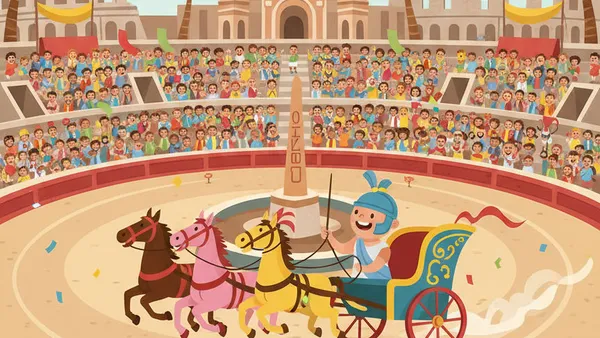
It is early morning in ancient Rome. The streets are already packed with people pushing toward the Circus Maximus. Tucked in the valley between the Palatine and Aventine hills, this massive stadium was the ancient world’s largest venue. Historians estimate it held up to 250,000 spectators—imagine fitting an entire city’s population into one arena!
Before the racing starts, the day kicks off with the Pompa circensis, a grand religious parade. Accompanied by loud music, trumpets, priests, and dancers, the charioteers enter the arena with pride. It's a colorful spectacle that signals the start of the city's favorite sport.
Gods are the guests of honor here. Heavy statues of Roman deities are paraded on special wagons because these games aren't just entertainment; they are sacred festivals. The crowd's energy is electric as vendors shout their wares and families scramble for the best seats to see the superstars of the era.
Key Takeaway
Race day began with the 'Pompa circensis,' a grand religious parade honoring the gods.
Test Your Knowledge
Why were statues carried during the opening parade?
At the Circus Maximus, you aren't just a spectator; you're a fanatic. Just like modern football clubs, ancient Rome had four powerful racing stables called factions. They were distinguished by their colors: Red, White, Blue, and Green.
Fans were intensely loyal. Emperor Caligula was such a 'Green' fanatic that he allegedly ate and slept in the stables with his favorite horses! Supporters wore their team’s colors, chanted songs, and screamed at rivals. For most Romans, team loyalty was a lifelong commitment.
Charioteers were the megastars of their time. Often starting as slaves or from poor backgrounds, they could rise to incredible fame. If they won enough races, they became unfathomably wealthy—some even earned more than top politicians. Every fan knew their names and the pedigrees of their best horses by heart.
Key Takeaway
Romans were fiercely loyal to one of four racing teams: Red, White, Blue, or Green.
Test Your Knowledge
How did ancient Roman fans show their support at the races?
The parade ends, and tension peaks. The horses neigh nervously in their starting gates, known as Carceres. Charioteers prepare for the world's most dangerous race in four-horse chariots called Quadrigas.
Drivers wrap the reins tightly around their waists to use their body weight for control. This is incredibly risky. To survive a crash, every driver carries a razor-sharp knife in his belt. If the chariot flips, he must cut himself free in a split second, or he will be dragged to death by his own team.
Suddenly, silence falls over the stadium. High in the royal box, the organizer lifts a white cloth called the Mappa. He waits a heartbeat, then lets it fall. As soon as the fabric hits the ground, the gates fly open with a bang, and the chariots explode onto the sand track!
Key Takeaway
The race began when the organizer dropped a white cloth (Mappa), triggering the starting gates.
Test Your Knowledge
Why did charioteers always carry a sharp knife during the race?
The race is on! A standard contest lasted exactly seven laps, covering about six kilometers. Light wooden chariots thunder across the sand, jostling for position. In the center is the Spina, a long wall decorated with magnificent statues.
At each end of the wall are the Metae—golden turning posts. This is the danger zone. Drivers try to take the corners as tight as possible to save time, often leading to spectacular and violent 'shipwrecks' as chariots collide and shatter.
To help the crowd track the chaos through the dust, there’s an ancient scoreboard on the Spina. Large wooden eggs or bronze dolphins are flipped over for every completed lap. This way, every spectator in the stands knows exactly when the final, heart-stopping lap begins!
Key Takeaway
The most dangerous points were the Metae (turning posts) at the ends of the central track.
Test Your Knowledge
How did spectators know how many laps were left to race?
After ten minutes of breathtaking speed, the first chariot crosses the finish line. The winning fans erupt in joy, while the losers curse their luck. A full race day featured up to 24 such spectacles, keeping the audience on a constant emotional rollercoaster.
Inside the arena, the winner is hailed as a hero. He receives a traditional palm branch and a laurel wreath as symbols of his triumph. But the real prize is the money. A successful charioteer could earn more gold in a single day than a common Roman laborer could earn in a lifetime.
As the sun sets over Rome’s hills, thousands of exhausted fans flood back into the city’s narrow streets. The blood and dust in the Circus Maximus are smoothed over by workers, making the track ready for the next day of speed, risk, and glory.
Key Takeaway
Winners received a palm branch and massive prize money, making them incredibly wealthy superstars.
Test Your Knowledge
What was the main prize that made winning charioteers so wealthy?
Track your progress, earn XP, and compete on leaderboards. Download NerdSip to start learning.