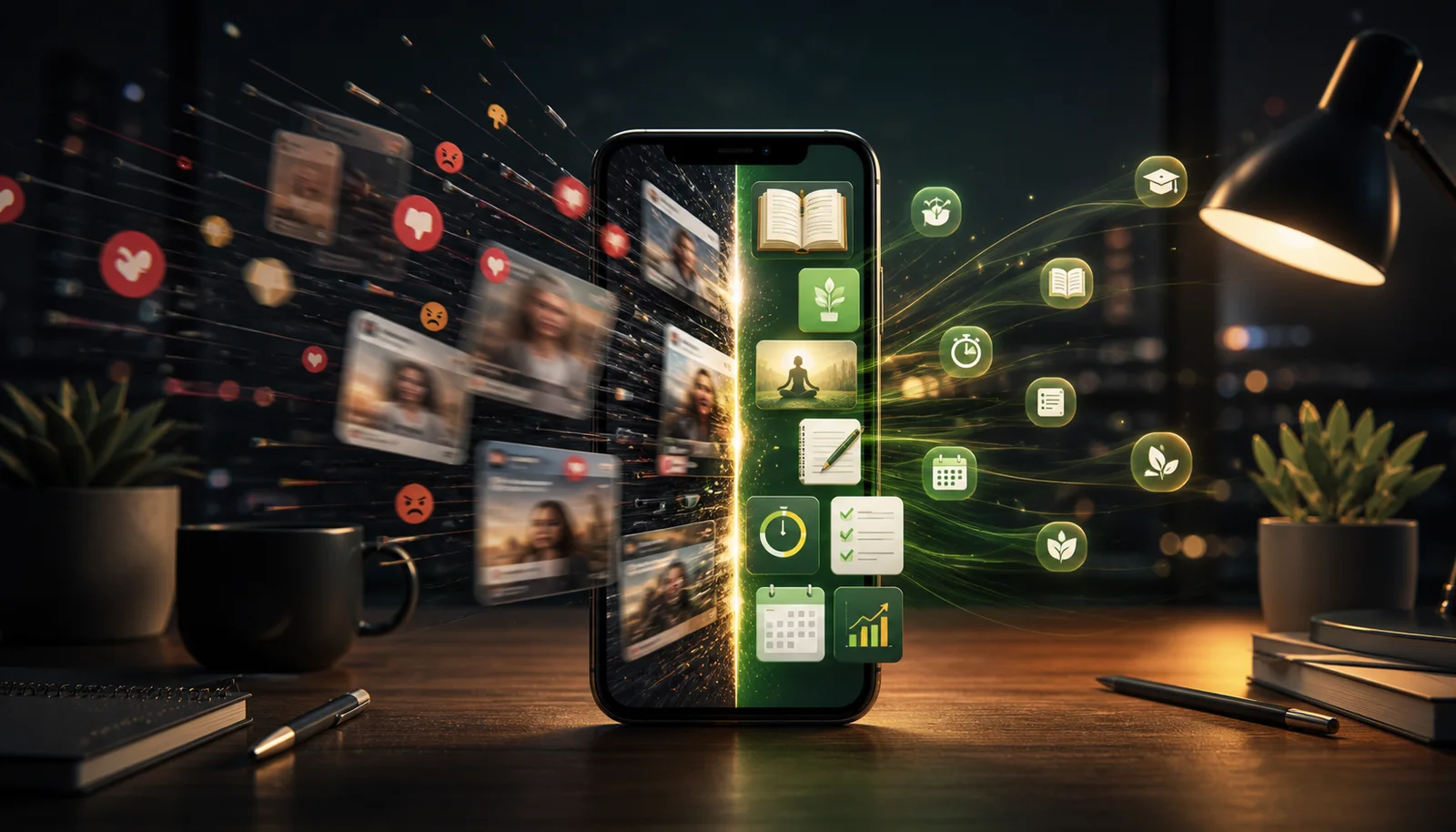
Every guide about quitting social media gives you the same advice. Delete the apps. Set screen time limits. Go for a walk. Read a book.
None of it works. Not for long, anyway.
The reason is simple. Social media isn't one habit. It's a bundle of cravings wearing a trench coat. Sometimes you open Instagram because you're bored and want a quick hit of stimulation. Sometimes you open TikTok because you want to discover something new. Sometimes you open Twitter because you want to feel connected to other people. Each time feels like the same behavior, but the underlying itch is completely different.
Deleting the app removes the delivery system. It does nothing about the craving. So you reinstall it three days later, because your brain still needs something in those dead moments between tasks, and willpower is a terrible long-term strategy.
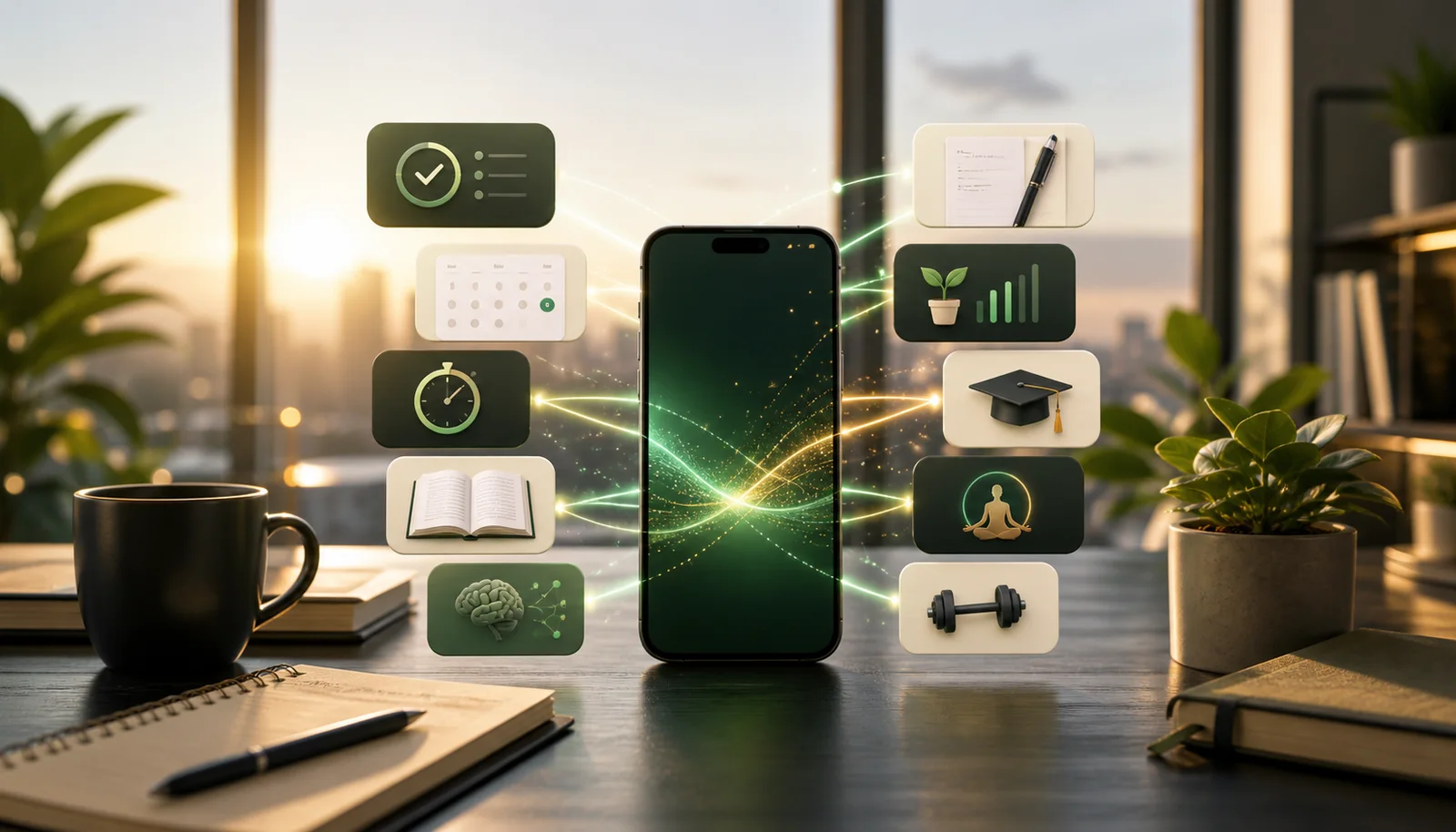
The fix isn't to stop reaching for your phone. It's to make sure the right app is waiting when you do.
This guide sorts replacement apps by the specific craving they satisfy. Find the one that matches your itch. That's the one that will stick.
Before the categories, the underlying rule. A replacement only holds if it pays what the feed was paying, and that is four specific things rather than one. This video walks through them and names three apps that qualify.
1. The Quick Dopamine Hit: Puzzle and Strategy Games
The craving: You want a small win. Something to tap, solve, or beat. The same reward loop that makes likes and comments feel so good.
Social media delivers dopamine through unpredictability. You never know if the next scroll will be boring or incredible, and that variable reward schedule is what makes it addictive. Puzzle games tap into the same circuit, but they reward you for actually thinking.
Best picks in this category
Chess (Chess.com or Lichess) is the gold standard. A 5-minute blitz game scratches exactly the same itch as checking your notifications, except you're training pattern recognition, planning, and strategic thinking. Lichess is completely free with no ads. Chess.com has a larger player base and better puzzles behind its paywall.
The New York Times Games bundle (Wordle, Connections, Strands, the Mini Crossword) gives you a daily ritual with a hard stop. You solve today's puzzles, you're done. There's no infinite feed pulling you back in. That built-in endpoint is what makes these so effective as social media replacements. The games are challenging enough to feel satisfying, short enough to fit in a coffee break.
Sudoku (any well-rated app will do) is pure focused attention. No notifications, no social features, no variable rewards. Just a grid and your brain. If your social media habit is really an anxiety habit, sudoku's quiet predictability is surprisingly calming.
Why games work as replacements: They have something social media deliberately lacks: an ending. A chess match concludes. A crossword gets solved. A sudoku grid fills up. Social media is engineered to never finish. Games give your brain the satisfaction of completion, which is the thing the algorithm is specifically designed to withhold from you.
2. The Discovery Craving: Micro-Learning Apps
The craving: You want to stumble across something interesting. That feeling of "huh, I didn't know that" is what keeps you scrolling through Reddit threads and TikTok rabbit holes.
This craving is the sneakiest one, because it feels productive. You tell yourself you're learning things on social media. And occasionally you are. But the ratio of genuine insight to recycled content, outrage bait, and time-wasting is roughly 1 to 50. Micro-learning apps flip that ratio.
Best picks in this category
NerdSip is built specifically for this craving. You pick any topic that interests you, literally anything, and the app generates a structured micro-course with lessons, quizzes, and visual infographics. Each lesson takes about 5 minutes. The library already has over 500 courses spanning psychology, history, science, philosophy, negotiation, and dozens of other categories. But the real differentiator is that you're not limited to a pre-built catalog. Curious about the economics of coffee farming? The history of cryptography? How nuclear reactors actually work? Type it in and get a course.
Swapping one feed for another only pays off if the new one is right. Generation runs against live search results, a nightly pass scores every course for content integrity, anything below the bar never reaches you, and one tap reports a lesson to a human reviewer.
PC Tech Magazine asked exactly this question in its NerdSip review: whether an AI microlearning app can genuinely replace social media, or only occupy the same minutes.
What makes NerdSip stick where other learning apps don't is the gamification layer. It runs on an MMORPG-style progression system: XP for completing lessons, loot drops with rarity tiers (Common, Rare, Legendary), leaderboards, streaks, and a full inventory system. It sounds excessive until you realize you've spent 30 minutes learning about behavioral economics instead of 30 minutes watching strangers argue about nothing. The dopamine comes from leveling up, not from outrage. That's a trade worth making.
Free tier available on iOS and Android.
Duolingo works the same way for languages specifically. The gamification is excellent, the sessions are short, and the streak mechanic is genuinely motivating. If your discovery craving leans toward "I want to learn Spanish," Duolingo has that locked down. It just can't help you with anything outside of languages.
Brilliant covers math, science, and computer science through interactive problem-solving. The lessons are beautifully designed and genuinely challenging. If your curiosity skews technical, Brilliant is hard to beat. The price tag ($24.99/month) is steep, but the quality justifies it if you use it consistently.
Why micro-learning works as a replacement: It satisfies the same novelty-seeking behavior that drives social media scrolling, but it leaves you with something tangible. After 10 minutes on TikTok, you can't recall what you watched. After 10 minutes on a learning app, you know something you didn't before. Your brain gets the discovery hit it wanted, plus the satisfaction of actual retention.
3. The Self-Expression Craving: Creative Apps
The craving: You want to make something. Post something. Put a piece of yourself out into the world. Instagram and TikTok feel like creative outlets, but for most users they're consumption platforms dressed up as creative ones.
The vast majority of social media users are consumers, not creators. Even the people who post regularly are often performing rather than creating. Choosing a filter and writing a caption isn't the same as making something. Creative apps give you the actual experience of building, drawing, writing, or composing, the thing social media only pretends to offer.
Best picks in this category
Procreate Pocket (iOS) or Sketchbook (Android) turns your phone into a drawing studio. You don't need to be an artist. Doodling with a finger on your phone while waiting for the bus is more creatively fulfilling than posting a story. Procreate Pocket is a one-time $6.99 purchase. Sketchbook is free.
GarageBand (iOS, free) lets you make actual music with zero training. The smart instruments auto-correct your timing and key so everything sounds good. You can lay down a drum beat, add bass, record a melody, and have a rough song in 15 minutes. It's play in the purest sense, something social media has engineered out of phone use.
Canva (iOS and Android, free tier) is design for non-designers. Make posters, presentations, social graphics, or just play with typography and color. If your Instagram habit is really about visual aesthetics, Canva lets you create that beauty instead of passively consuming it.
Your phone's Notes app is underrated as a creative tool. Write a poem. Draft a short story. Keep a running list of observations. Write a letter to someone you won't send. Writing is the most accessible creative act that exists, and you already have the app installed.
Why creative apps work as replacements: Social media gives you the illusion of creative participation. You curate, you react, you share. Creative apps give you the real thing. The feeling after making something, even something small and imperfect, is fundamentally different from the feeling after scrolling. One fills you up. The other empties you out.
4. The Content Consumption Craving: Reading and Listening Apps
The craving: You want to consume content. Stories, ideas, arguments, information. You want to sit back and take something in.
This is the most legitimate craving on the list. There's nothing wrong with wanting to consume content. The problem with social media is the delivery mechanism: an infinite feed controlled by an engagement algorithm that optimizes for time-on-app, not quality. Reading and listening apps give you the same consumption experience with one critical difference: the content has a beginning, middle, and end.
Best picks in this category
Libby connects to your local library card and gives you free access to ebooks and audiobooks. Thousands of titles, zero cost. The reading interface is clean, the audiobook player is solid. Most people forget they have a library card. Libby makes it useful again.
Kindle turns your phone into a book. The reading experience is comfortable even on a small screen, and Whispersync lets you switch between reading and listening to the same title. If you read for even 10 minutes in the moments you'd normally scroll, you'll finish a surprising number of books per year.
Pocket saves articles and web pages for distraction-free reading later. When you find something interesting during the day, save it. When you're bored later, open Pocket instead of Reddit. You get curated content without the algorithm deciding what comes next.
Any good podcast app (Overcast, Pocket Casts, or even Apple/Google Podcasts) replaces the passive consumption of social media with long-form listening. A 45-minute conversation between two experts on a topic you care about delivers more value than three hours of social media ever will.
Why reading and listening apps work: They satisfy the content craving without the infinite scroll. A book chapter ends. A podcast episode concludes. An article has a final paragraph. Your brain gets the "I consumed something interesting" reward without the open-ended time drain that social media relies on to keep you engaged past the point of enjoyment.
5. The Community Craving: Fitness and Movement Apps
The craving: You want to feel connected to other people. You want to see what your friends are doing. You want a sense of belonging to something.
This is the craving that makes social media the hardest to quit. Humans are wired for social connection, and platforms like Instagram exploit that wiring brilliantly. The problem is that social media delivers a counterfeit version of connection: you see curated highlights of other people's lives and compare them to the unfiltered reality of yours. That's not connection. It's surveillance.
Fitness apps offer something closer to real social interaction because the shared activity is physical, specific, and honest. Nobody can fake a 5K run time.
Best picks in this category
Strava is social media for people who move. The feed shows runs, bike rides, hikes, and walks from people you follow. You give kudos (Strava's version of likes) and leave comments. Segment leaderboards add friendly competition. The key difference: every post on Strava represents someone doing something difficult with their body. The social comparison that happens here pushes you to move more, not to feel worse about yourself.
Nike Run Club is more focused on personal progress. Guided runs, milestone celebrations, and weekly summaries make solo running feel supported. The challenges feature lets you compete with friends on monthly distance goals.
Peloton (the app, not the bike) offers classes for running, walking, yoga, strength, and meditation starting at $12.99/month. The live and on-demand classes create a sense of community. Hundreds of thousands of people taking the same class creates a surprising feeling of shared experience, even though you're alone in your living room.
Why fitness apps work as replacements: They provide genuine social connection around a shared activity that improves your life. The "social" part of social media is what keeps people hooked. Fitness apps prove you can have the community without the comparison trap, the outrage, or the algorithm.
6. The Wind-Down Craving: Mindfulness and Journaling Apps
The craving: You need to decompress. It's late, you're tired, and you want something low-effort to occupy your brain before sleep.
This is the most destructive craving on the list, not because it's bad, but because of when it strikes. Late-night doomscrolling is the worst form of social media use. Blue light disrupts melatonin production. Emotionally charged content activates your nervous system right when you need it to shut down. You go to bed later, sleep worse, and wake up groggier. Every night.
Mindfulness and journaling apps address the same "I need something gentle before bed" impulse without sabotaging your sleep.
Best picks in this category
Headspace offers guided meditations starting at 3 minutes, plus sleep sounds and wind-down exercises. The Sleepcasts (narrated stories designed to bore you to sleep in the best possible way) are particularly effective replacements for scrolling in bed. Limited free content; premium is $12.99/month or $69.99/year.
Calm is Headspace's main competitor with a slightly different vibe. The Daily Calm is a 10-minute guided session that works well as a bedtime ritual. The Sleep Stories narrated by celebrities (Matthew McConaughey reading you to sleep is as relaxing as it sounds) are uniquely effective. $14.99/month or $69.99/year.
Day One (journaling) gives you a private space to write about your day, your thoughts, or nothing in particular. Journaling before bed is one of the most evidence-backed ways to reduce rumination and improve sleep quality. Day One's interface is clean and distraction-free. Free tier available; premium is $2.92/month.
Why mindfulness apps work as replacements: They meet you in the exact moment social media does the most damage. Trading 20 minutes of Twitter at midnight for 10 minutes of Headspace is probably the single highest-impact swap on this entire list. You'll sleep better, wake up sharper, and reach for your phone less the following day. It compounds.
How to Match Your Craving to the Right App
Here's the cheat sheet. Be honest about why you pick up your phone, then install the matching replacement.
| When you feel... | You're craving... | Replace with... |
|---|---|---|
| Bored, want a quick win | Dopamine | Chess, Wordle, Sudoku |
| Curious, want to learn something | Discovery | NerdSip, Duolingo, Brilliant |
| Restless, want to make something | Self-expression | Procreate, GarageBand, Canva |
| Want to read or listen to something good | Content | Kindle, Libby, Pocket, Podcasts |
| Lonely, want to feel connected | Community | Strava, Nike Run Club, Peloton |
| Tired, want to wind down | Rest | Headspace, Calm, Day One |
Don't install all of these. Pick the two or three cravings that drive most of your social media use, and install one app for each. Move them to your home screen, right where Instagram or TikTok used to be. Let muscle memory do the work.
The Craving Framework Makes It Stick
Most advice about quitting social media fails because it treats the problem as a single habit. It's not. It's a cluster of habits that share a single trigger: picking up your phone.
When you understand which craving is driving each reach for your phone, you can slot in a replacement that satisfies the same need. You're not fighting your brain. You're redirecting it.
The puzzle game satisfies the same reward circuit as the like button. The micro-learning app satisfies the same curiosity as the Reddit rabbit hole. The fitness tracker satisfies the same social need as the Instagram feed. Your brain barely notices the difference, except that you feel better afterward instead of worse.
Start with one swap. The next time you feel the pull, notice what you're actually craving. Then open the app that matches. Give it two weeks. The old habit will lose its grip faster than you expect.
Frequently Asked Questions
What are the best apps to use instead of social media?
The best replacement depends on why you reach for social media. For quick dopamine hits, puzzle and strategy games like chess or word games work well. For discovering new things, micro-learning apps like NerdSip cover any topic in 5-minute lessons. For self-expression, creative apps like Procreate or GarageBand fill the gap. For content consumption, Kindle or Libby replace the endless scroll with real reading. For community, fitness apps like Strava give you a healthy social feed. For winding down, Headspace or journaling apps are far better than midnight doomscrolling.
Why is it so hard to quit social media?
Because social media isn't one habit. It satisfies multiple psychological needs: boredom relief, curiosity, social connection, self-expression, and the need to wind down. Deleting the app only removes the delivery mechanism, not the underlying craving. That's why matching each craving to a specific replacement app is more effective than willpower alone.
Can games be a healthy alternative to social media?
Yes, if you pick the right ones. Puzzle and strategy games like chess, sudoku, crosswords, and word games activate the same reward circuits as social media likes, but they sharpen your brain instead of draining it. The key is choosing games with clear endpoints rather than infinite loops. A chess match ends. A sudoku puzzle has a solution. Social media never stops.
What is the best app to replace TikTok?
For the short-form dopamine and discovery that TikTok provides, NerdSip is the closest productive match. Each lesson takes about 5 minutes, covers a topic you actually chose, includes quizzes and visual infographics, and has MMORPG-style gamification with XP, loot drops, and leaderboards. You get the same quick-hit satisfaction without the algorithmic rabbit hole.
Every NerdSip course clears a four-layer fact-checking pipeline before it reaches the app: grounded in live sources, scored nightly, gated on failure, and reviewable by a person at one tap. Articles on this blog are drafted with AI assistance, then researched, verified, and edited by our team.
Editorial responsibility: Philip S., ai51 UG (haftungsbeschränkt) — contact via imprint.
📚 Keep Learning
- 9 Best Productive Apps Instead of Social Media in 2026
- 10 Best Apps to Replace Social Media in 2026 (That Actually Work)
- 11 Best Productive Apps in 2026: Tools That Actually Make Your Phone Useful
- How to Turn Scroll Addiction Into Learning: Break the Dopamine Loop
- The Dopamine Trap: Why You Can't Stop Scrolling Even When You Hate It (Part 2 of 3)
- You Have Brain Rot (And It's Worse Than You Think): How to Fix It
Explore the NerdSip learning hubs
The blog is our editorial layer. When you want to move from reading into doing, these hubs organize the rest of NerdSip by format, including the app itself and the press that has written about it.
Replace the Scroll With Something Real
NerdSip turns idle phone time into knowledge. 5-minute lessons on any topic, gamified so you actually keep coming back. Free to download.