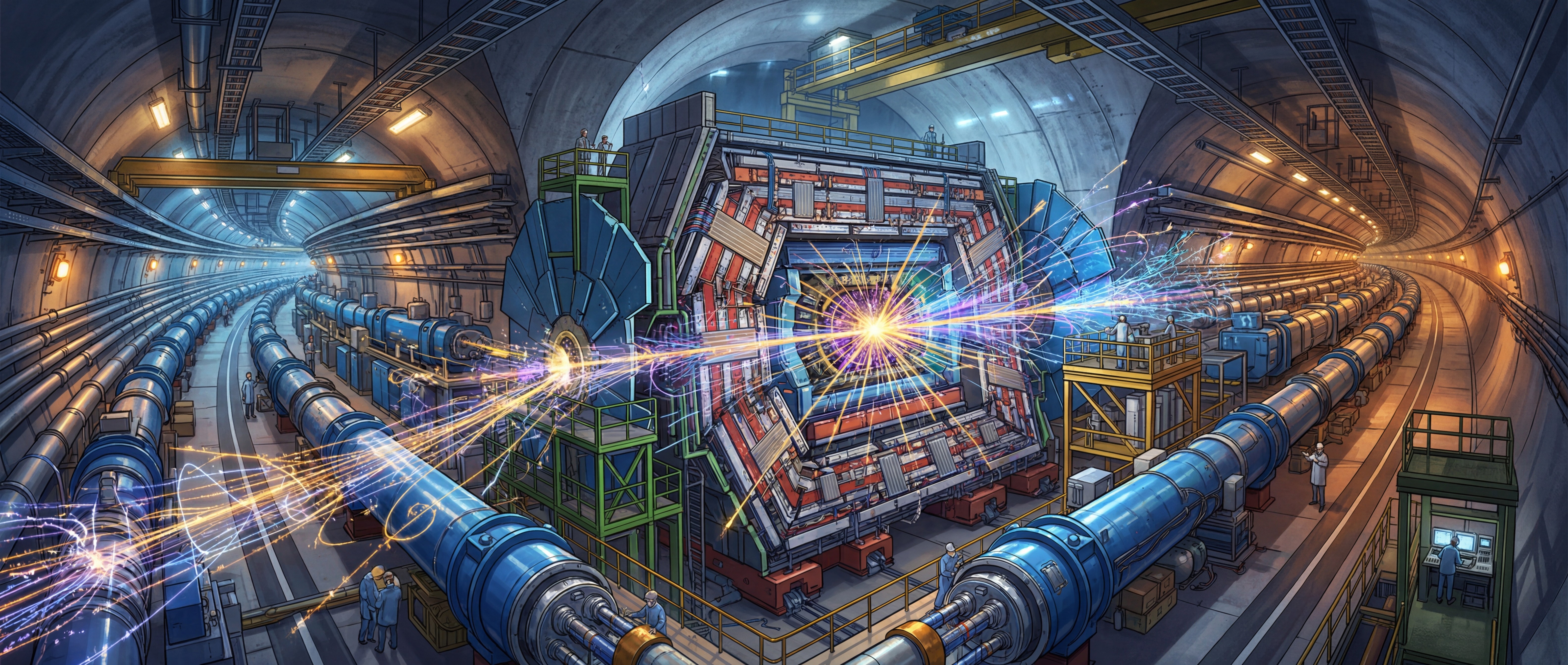
The Most Complex Machine Ever Built
One hundred meters beneath the Swiss-French border, a ring of superconducting magnets stretches 17 miles in circumference. Inside it, protons accelerate to 99.9999991% the speed of light, completing 11,245 laps per second. Then they collide. And for a fraction of a fraction of a second, conditions recreate the first moments after the Big Bang. This is the Large Hadron Collider. This is where we go to ask the universe what it is made of.
Finding the Invisible
On July 4, 2012, CERN announced the discovery of the Higgs boson, the particle that gives other particles mass. It had been predicted in 1964 by Peter Higgs and five other physicists. It took 48 years, $13.25 billion, and the collaboration of over 10,000 scientists from 100 countries to confirm it existed. The ATLAS detector alone is seven stories tall, weighs 7,000 tons, and contains more wiring than the city of Geneva. It records 40 million particle collisions per second, searching for anomalies measured in billionths of a billionth of a meter.
What We Still Do Not Know
The Higgs was a triumph. But it was also the beginning. The Standard Model of physics, our best description of reality at the subatomic level, accounts for only 5% of the universe. The remaining 95% is dark matter and dark energy, substances we can measure the effects of but cannot see, cannot touch, and do not understand. The LHC is searching for supersymmetric particles, extra dimensions, and evidence of phenomena that could rewrite the laws of physics entirely. We built a machine to answer one question. It gave us a hundred new ones.
Collisions That Changed Everything
CERN also gave us the World Wide Web. Tim Berners-Lee invented it there in 1989 to help physicists share data. Antimatter was first produced in quantity at CERN. Medical imaging technology traces back to detector innovations built for particle physics. The most abstract science on Earth keeps producing the most practical inventions. That is what happens when you let curious people build impossible machines.
Want more rabbit holes?
NerdSip delivers bite-sized wonders to your phone. Every day.