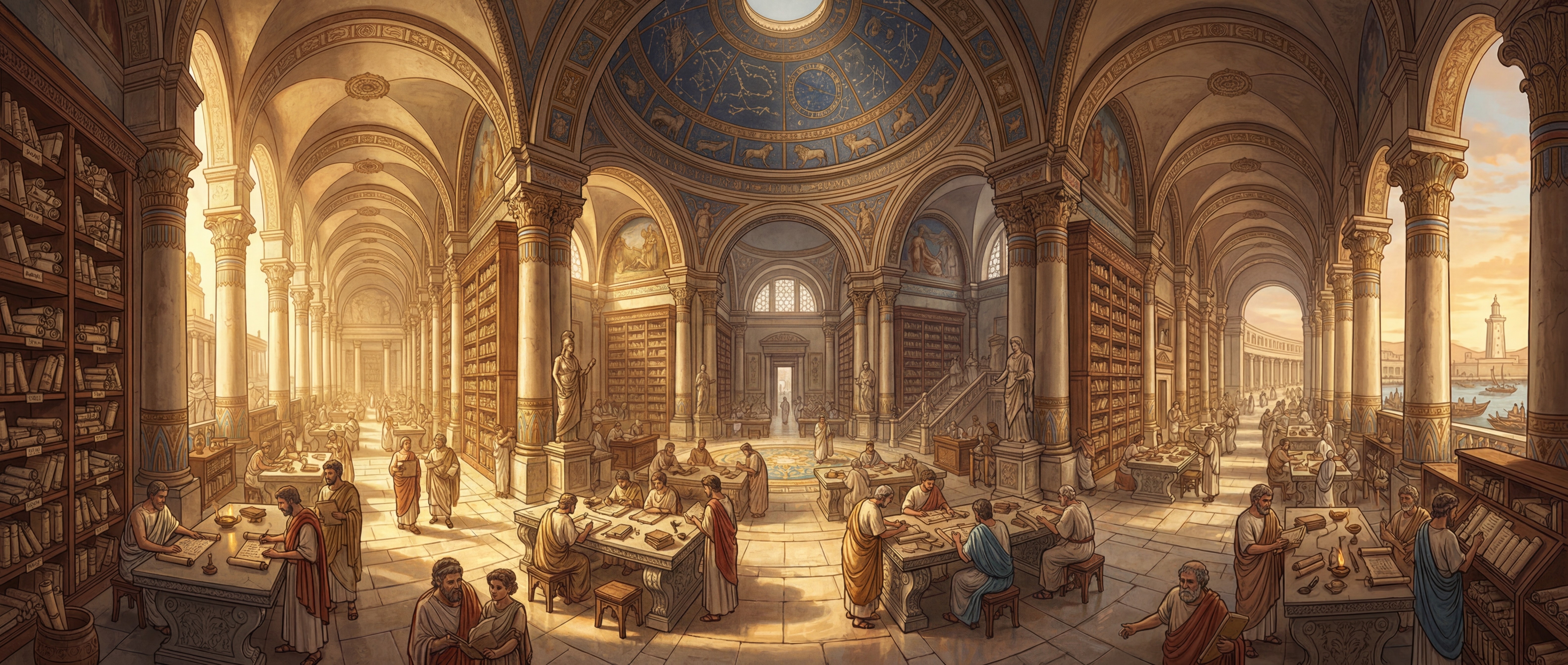
The Center of Everything Known
Around 300 BCE, Ptolemy I built more than a library. He built a machine for collecting the entire sum of human knowledge. Every ship entering the port of Alexandria was searched. Every scroll found was copied. The copy went back to the owner. The original stayed. At its peak, the Library held an estimated 400,000 scrolls. Works of Aristotle, Euclid, Archimedes, Hipparchus. Plays we will never read. Sciences we had to rediscover centuries later.
More Than a Building
The Library was the heart of the Mouseion, a research institution that would not be matched for over a millennium. Scholars lived there on royal stipends. Eratosthenes calculated the circumference of the Earth within 2% accuracy using shadows and geometry. Aristarchus proposed that the Earth orbited the Sun, 1,800 years before Copernicus. Herophilus performed the first systematic dissections of the human body, mapping the nervous system. All of this, in one place, funded by kings who understood that knowledge was power.
No Single Fire
The popular story is simple: one fire, one villain, everything lost. The truth is messier and more painful. Julius Caesar accidentally burned part of it in 48 BCE during a naval siege. Christian mobs destroyed the Serapeum, a secondary library, in 391 CE. Centuries of declining royal funding hollowed out the collection. Political purges drove scholars away. The Library did not die in a blaze. It withered. A thousand small decisions, each one forgettable, together amounting to catastrophe.
What Was Lost
We know the names of works that vanished. Histories of civilizations now forgotten. Mathematical proofs that had to be rediscovered from scratch. Medical texts that could have advanced healing by centuries. The loss of the Library of Alexandria is not just a historical tragedy. It is a permanent reminder of how fragile knowledge is. And how easily a civilization can forget what it once knew.
Want more rabbit holes?
NerdSip delivers bite-sized wonders to your phone. Every day.