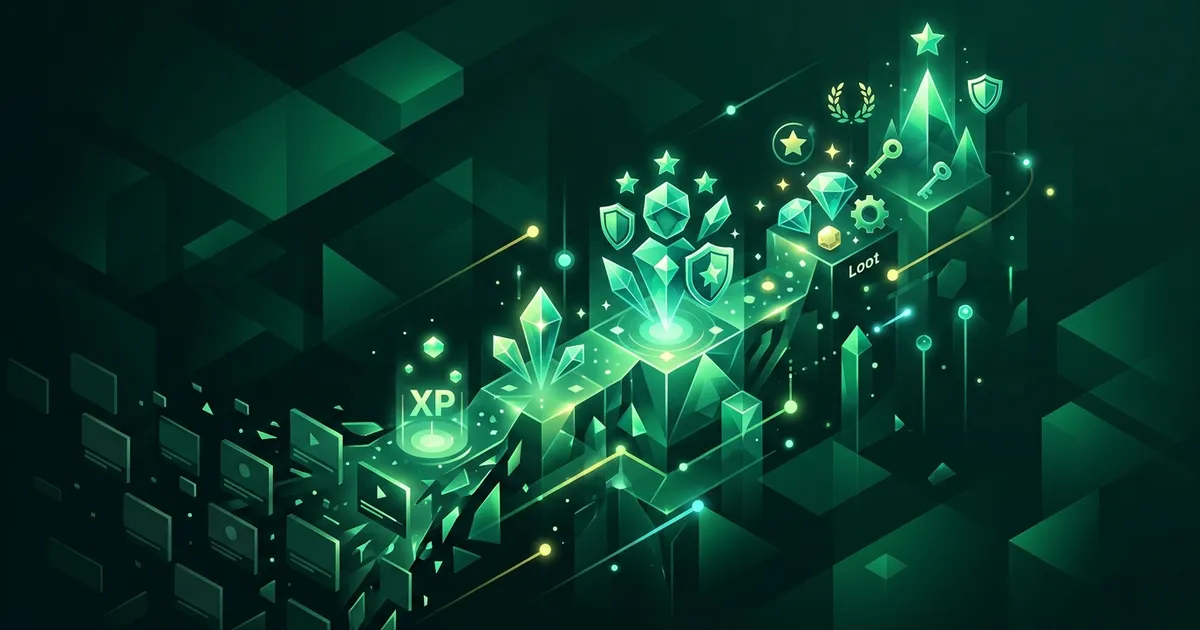
You've spent hundreds of hours in RPGs. Maybe thousands. Leveling characters, collecting loot, grinding for that rare drop. Every quest completed gives you XP. Every level unlocked gives you new abilities. The progress bar fills, something in your brain fires, and you keep going. You don't need willpower. You don't need motivation. The system carries you forward.
Now imagine that exact system, but instead of learning fictional sword techniques, you're learning about cognitive biases. Instead of looting enchanted armor from a dungeon boss, you're earning rewards for completing a lesson on behavioral economics. The XP is real. The leaderboard is real. The progression is real. But the knowledge you gain is useful in your actual life.
That's a learning RPG. And it's quietly becoming one of the most effective education models of 2026.
The Core Mechanics
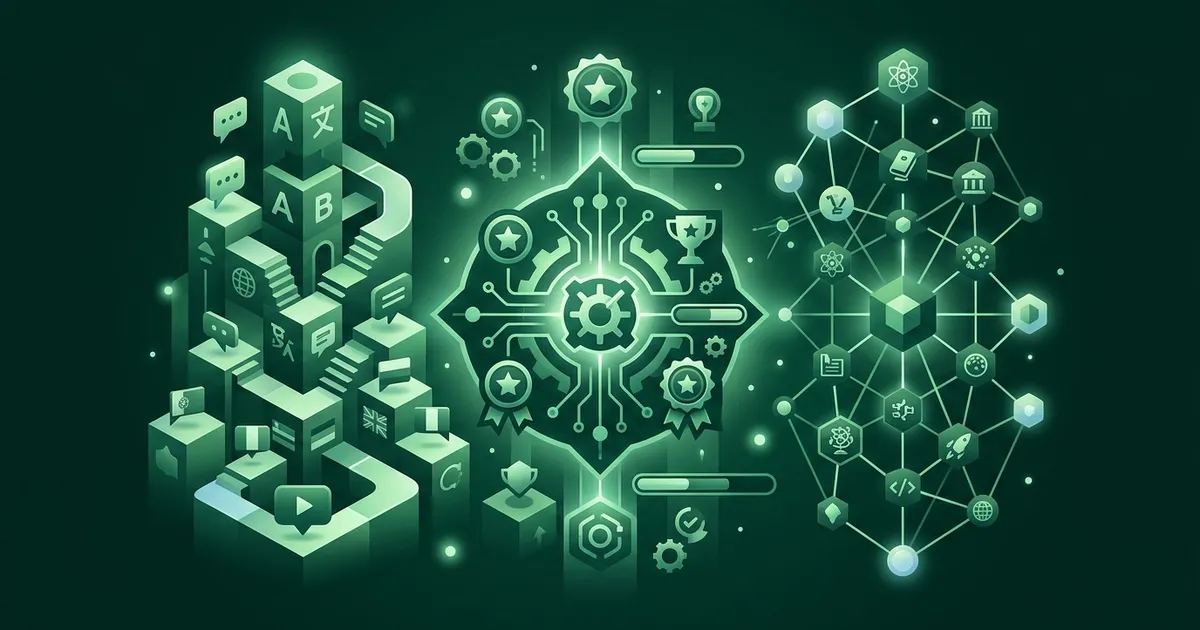
A learning RPG takes the progression systems that video games have spent decades perfecting and redirects them at education. The specific mechanics vary between apps, but the core elements are consistent.
XP (Experience Points). Every lesson you complete earns XP. This is the most basic RPG mechanic and the most important. XP transforms learning from an abstract, unmeasurable activity into something concrete and trackable. You finished a lesson on the psychology of persuasion. You earned 50 XP. That number goes up. Your brain registers progress. Tomorrow, you want to make it go up again.
Loot and Rewards. After completing certain milestones, you receive items or rewards. In NerdSip, every completed lesson has a chance to drop loot: 80% Common, 15% Rare, 5% Legendary. The rarity system creates anticipation. You don't know what you'll get. That uncertainty is the same psychological hook that makes loot systems in games like Diablo or Destiny compelling. You're not just learning for the knowledge. You're learning for the next drop.
Leaderboards and Competition. Global or weekly leaderboards let you see how you rank against other learners. This adds a social dimension to what is otherwise a solitary activity. Competition motivates differently than rewards do. Some people don't care about loot but will grind for hours to climb a leaderboard. Both types of motivation push you toward the same outcome: more learning.
Streaks and Daily Engagement. Consecutive daily logins and lesson completions build a streak. This is loss aversion in its purest form. A 50-day streak isn't just a number. It's an investment. Breaking it feels like losing something valuable. This mechanic, borrowed from Duolingo and refined by mobile gaming, is what turns occasional use into daily habit.
Progression and Mastery. As you complete courses and accumulate XP, you advance through a progression system. You're not the same learner at level 30 that you were at level 1. The visual and numerical proof of your growth creates a narrative: you are getting smarter, and you can see it happening. This is the part that traditional education gets most wrong. Feedback is delayed by weeks or months. In a learning RPG, feedback is instant.
Why RPG Mechanics Work for Learning
This isn't just a clever marketing wrapper. There's real science behind why RPG mechanics make learning more effective.
Variable reward schedules. The loot drop system uses what psychologists call a variable ratio schedule. You know a reward is coming, but you don't know exactly when or how good it will be. This is the same mechanism that makes slot machines compelling and social media feeds addictive. The difference is what the behavior produces. Slot machines take your money. Social media takes your time. A learning RPG gives you knowledge.
Progress visualization. The human brain is terrible at perceiving gradual improvement. You can't feel yourself getting smarter day by day. But you can see an XP bar filling up. You can see your leaderboard rank climbing. You can see your course completion percentage increasing. RPG mechanics make invisible progress visible, and visible progress is motivating.
Identity formation. In a traditional RPG, you don't just play a character. You become one. The same thing happens in a learning RPG. After maintaining a 60-day streak and completing 30 courses, you start to identify as a learner. "I'm the kind of person who learns something every day" becomes part of your self-image. James Clear wrote about this in Atomic Habits: the most powerful driver of behavior change isn't goals or rewards but identity. RPG mechanics accelerate identity formation by giving you a visible, quantified version of who you're becoming.
Flow state triggers. RPGs are masterful at maintaining the balance between challenge and skill that produces flow. Too easy, and you're bored. Too hard, and you're frustrated. The sweet spot is where learning happens fastest and feels most engaging. A well-designed learning RPG calibrates lesson difficulty to keep you in that zone, much like how game designers tune enemy difficulty curves.
We explored the broader science of gamification in our deep dive on why gamification works. The RPG model is essentially gamification's most evolved form.
Learning RPGs vs. Basic Gamification
Most learning apps in 2026 claim to be "gamified." The word has become almost meaningless. A badge here, a progress bar there, and suddenly the marketing page says "gamified learning experience."
A learning RPG is different. The distinction matters.
Basic gamification adds game elements to an existing product as decoration. The core experience is still the same. You're still reading a lesson or watching a video. The badge at the end doesn't change how you interact with the content. It's a sticker on a textbook.
A learning RPG makes the game mechanics integral to the experience. The progression system isn't added on top. It's woven into every interaction. Completing a lesson isn't just reading and moving on. It's earning XP, potentially getting a loot drop, watching your streak extend, and seeing your leaderboard position shift. Each of these micro-events creates a psychological response that reinforces the behavior.
The difference is measurable. Research shows that surface-level gamification (badges and points alone) increases engagement by 10 to 15 percent. Deep gamification with RPG mechanics can increase engagement by 40 to 60 percent and improve completion rates by 25 to 40 percent. The depth of the system determines the depth of the behavioral change.
Examples of Learning RPGs in 2026
NerdSip is the most fully realized learning RPG for general knowledge. The MMORPG-style progression includes XP, loot drops with rarity tiers, global leaderboards, streaks, and a course library of thousands of topics spanning psychology, science, history, philosophy, social skills, and more. Each lesson takes five minutes and includes active recall quizzes. The RPG mechanics aren't a layer on top of the learning. They are the structure around which every lesson is built. If you're looking for the app that best fits the "learning RPG" definition, this is it.
Duolingo pioneered gamification in education and uses some RPG elements: XP, leagues, streaks, and character progression. But it's limited to language learning, and the gamification is lighter than a full RPG model. No loot system, no rarity tiers, no MMORPG-style progression. It's closer to a gamified learning app than a learning RPG in the strictest sense.
Habitica applies RPG mechanics to habit tracking, not learning specifically. You create a character, earn rewards for completing habits, and lose health when you skip them. It's a gamified productivity tool rather than an educational platform, but it demonstrates how well RPG mechanics work for behavior change.
Classcraft brings RPG mechanics to K-12 classrooms. Students create characters with powers, earn points for participation, and go on quests tied to their coursework. It's teacher-mediated and classroom-specific, but it shows the model working in formal education settings.
Who Learning RPGs Are For
Not everyone responds to RPG mechanics. But a surprisingly large percentage of people do, including many who don't consider themselves "gamers."
People who loved Duolingo's gamification but want more. If you found yourself addicted to Duolingo's XP system and wished it existed for other subjects, a learning RPG is exactly what you're looking for. It's the same behavioral loop, deeper mechanics, broader content.
Former gamers who feel guilty about screen time. If you used to spend hours in RPGs but now feel like that time should be "productive," a learning RPG lets you scratch the same itch while actually building knowledge. The dopamine comes from the same place. The outcome is different.
People who can't stick with online courses. The average completion rate for online courses is somewhere between 5 and 15 percent. That's not because the content is bad. It's because there's no behavioral system keeping you engaged. Learning RPGs solve this with the same tools that keep gamers coming back: progress, rewards, and social competition.
Doomscrollers looking for a replacement. If your default idle behavior is opening social media, a learning RPG fills the same time slot with the same quick-hit dopamine pattern, except instead of losing 30 minutes to content you won't remember, you're completing lessons you will. We wrote more about this in our guide to apps that replace social media.
The Future of Learning RPGs
The learning RPG model is still young. NerdSip launched recently. The category barely has a name yet. But the trajectory is clear.
AI is making it possible to generate high-quality lesson content across thousands of topics. This solves the content bottleneck that kept general-knowledge platforms small. MMORPG mechanics are being adapted from decades of game design research. Mobile-first design means these experiences fit into the five-minute gaps in your day where learning actually happens.
The prediction here is straightforward: within a few years, "learning RPG" will be as recognized a category as "language learning app" or "meditation app." The ingredients are proven. XP works. Loot works. Leaderboards work. Streaks work. Active recall works. Combining all of them into a coherent progression system applied to education is not a gimmick. It's the logical conclusion of everything we know about how humans form habits and retain information.
The gamers already knew this. They've been experiencing optimized engagement systems for decades. The education world is just now catching up.
Under the game layer, the mechanics are the same ones that build ordinary breadth. See how to improve your general knowledge for the version without the XP bar.
Frequently Asked Questions
What is a learning RPG?
A learning RPG is an educational app or platform that uses role-playing game mechanics to drive learning. This includes XP (experience points) for completing lessons, loot drops or rewards for achievements, character progression systems, leaderboards, and streaks. The goal is to make learning as engaging and habit-forming as playing a video game.
What is the best learning RPG app?
For general knowledge, NerdSip is the most fully realized learning RPG. It uses MMORPG-style gamification with XP, loot drops (Common, Rare, and Legendary tiers), global leaderboards, and streaks across thousands of courses covering psychology, science, history, philosophy, and more. For language learning, Duolingo uses lighter RPG elements like XP and leagues.
Do learning RPGs actually work?
Yes. Research shows gamification increases engagement by up to 60% and can improve course completion rates by 25-40%. The RPG mechanics (XP, progression, loot) tap into the same psychological reward systems that keep gamers engaged for thousands of hours. The key difference is that the rewards are tied to actual learning, with quizzes and active recall ensuring knowledge retention.
Is NerdSip a learning RPG?
Yes. NerdSip is a learning RPG built around MMORPG-style progression. You earn XP for completing 5-minute lessons, receive loot drops with rarity tiers (80% Common, 15% Rare, 5% Legendary), compete on global leaderboards, maintain streaks, and progress through thousands of courses across topics like psychology, history, science, and philosophy.
Every NerdSip course clears a four-layer fact-checking pipeline before it reaches the app: grounded in live sources, scored nightly, gated on failure, and reviewable by a person at one tap. Articles on this blog are drafted with AI assistance, then researched, verified, and edited by our team.
Editorial responsibility: ai51 UG (haftungsbeschränkt). Responsible editor named in the imprint.
📚 Keep Learning
Explore the NerdSip learning hubs
The blog is our editorial layer. When you want to move from reading into doing, these hubs organize the rest of NerdSip by format, including the app itself and the press that has written about it.
Try a Learning RPG
NerdSip: thousands of courses. MMORPG gamification. 5-minute lessons. Free to download.
4.7 stars from 380 reviews · 10,000+ learners