You write a sentence. The AI generates a hundred lines of code. You hit run. It works. Something lights up in your chest, a small private thrill that has nothing to do with the quality of the output and everything to do with the speed at which your intention became reality. You type another sentence. The loop begins again.
If you have spent any time vibe coding, you recognize this feeling. Many developers describe it, sometimes proudly, sometimes with a note of concern, as addictive. The word is not chosen lightly. There is a reason the prompt-generate-test cycle feels the way it does, and that reason lives in the neurochemistry of your brain.
This article is an exploration of that neurochemistry. It draws on peer-reviewed research in behavioral neuroscience, operant conditioning theory, and observations from the developer community to examine why vibe coding activates the brain's reward circuitry with such intensity. It also offers practical guidance for developers who want to harness that intensity without being captured by it: how to vibe code securely, how to battle-test AI-generated output, and how to recognize when productive flow has crossed the line into compulsive behavior.
The goal here is not to alarm you. Variable reinforcement and dopamine are not pathologies. They are the neurochemical substrate of curiosity, exploration, and creative persistence. Understanding how they work makes you a better builder.
What Dopamine Actually Does (It Is Not What You Think)
The popular understanding of dopamine as a "pleasure chemical" is a significant oversimplification. Decades of neuroscientific research have established that dopamine is more accurately characterized as a neurotransmitter of motivation, anticipation, and prediction error. It fires not primarily when a reward is received, but when a reward is anticipated, and most intensely when the probability of receiving that reward is uncertain (Schultz, 2016).
This distinction matters enormously. Wolfram Schultz and colleagues demonstrated that midbrain dopamine neurons encode what neuroscientists call a reward prediction error signal. They fire above baseline when an outcome is better than expected, at baseline when it matches expectation, and below baseline when it falls short. The system is not designed to make you feel good. It is designed to make you want.
Fiorillo, Tobler, and Schultz (2003) showed that dopamine neurons exhibit sustained elevated firing during periods of reward uncertainty, with peak activation occurring at 50 percent reward probability. That is the point of maximum informational entropy. Maximum surprise potential. Maximum "I have no idea what is about to happen, but it might be great."
B.F. Skinner recognized the behavioral consequences of this decades before the neurochemistry was understood. In his operant conditioning experiments, Skinner found that variable ratio schedules, where rewards arrive unpredictably after a varying number of actions, produced the highest and most consistent rates of behavior, and those behaviors were extraordinarily resistant to extinction. An animal trained on a variable ratio schedule will keep pressing the lever long after the rewards stop, because the next press could be the one that pays off (Skinner, 1953).
The translation of these principles to digital products has been extensively documented. Clark and Zack (2023) demonstrated that social media, gaming, online shopping, and gambling products all exploit variable reward schedules to sustain engagement, with algorithmic personalization introducing novel forms of variability that earlier product generations could not achieve. Brady and Prentice (2021) found that the physiological arousal patterns of players opening loot boxes closely resemble those of gamblers at slot machines.
For the present analysis, the critical insight is this: any activity that delivers uncertain rewards contingent on repeated engagement has the structural prerequisites for activating dopamine-mediated compulsion loops. The specific content of the reward, whether it is a virtual sword, a social media notification, a revenue spike, or a successfully generated codebase, matters less than the schedule on which it is delivered and the degree of uncertainty it entails.
The Prompt-Generate-Test Loop: Why Vibe Coding Lights Up Your Brain
In February 2025, Andrej Karpathy coined the term "vibe coding" to describe a new approach to software development: describe what you want in plain language, let the AI generate the code, test the output, iterate. Within a year, the practice went from a provocative social media post to a mainstream methodology. The term was named Collins Dictionary's Word of the Year for 2025.
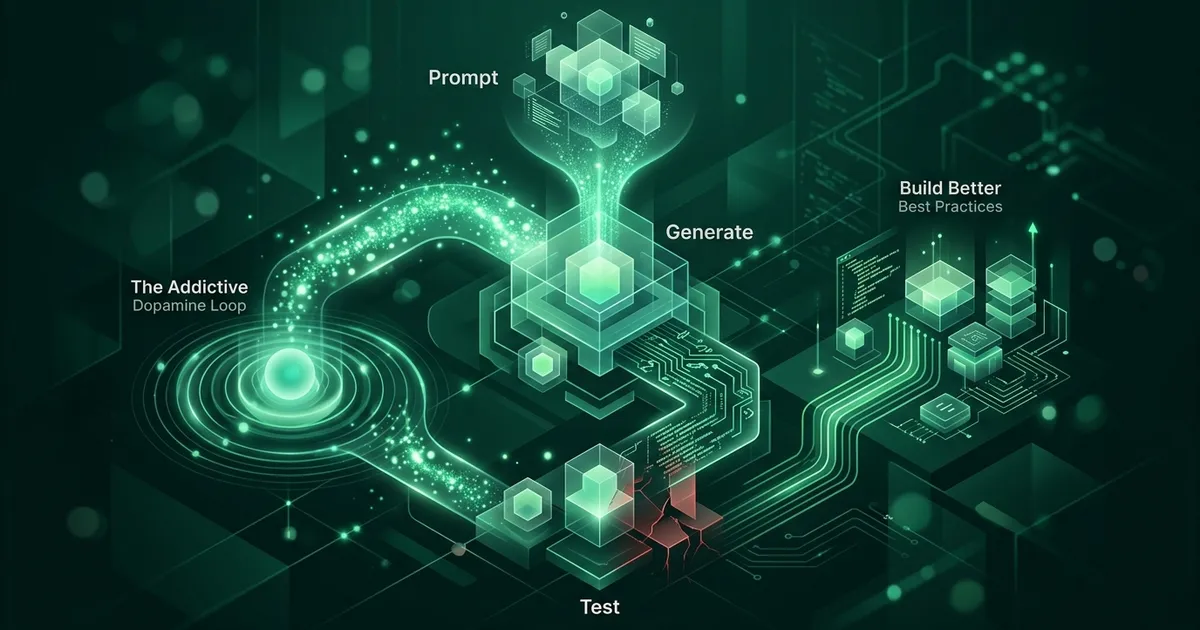
The core activity cycle of vibe coding, which we call the prompt-generate-test (PGT) loop, has four steps. You write a natural-language prompt describing desired functionality. The AI generates code. You test or preview the output. You evaluate and either accept or refine. This loop has structural properties that make it an unusually potent activator of the dopamine system.
Extremely Short Cycle Times
In traditional software development, the feedback loop between writing code and seeing results spans minutes, hours, or days. In vibe coding, the gap between prompt and output is measured in seconds. This temporal compression means you experience many more reward-evaluation events per unit of time. Each one is an opportunity for dopamine release. The subjective experience is rapid, almost continuous forward motion. Developers frequently describe it as flow.
Significant Outcome Uncertainty
When you write a prompt, the resulting code may be exactly what you intended, partially correct, entirely wrong, or surprisingly delightful in a way you did not anticipate. You cannot predict which outcome will occur. This unpredictability means each iteration functions as a trial in a variable ratio reinforcement schedule. The AI model, in effect, becomes a kind of cognitive slot machine: each prompt is an action performed in anticipation of an uncertain reward.
Near-Zero Cognitive Friction
In traditional development, the "action" required to earn the reward of working software involves writing, debugging, and testing code. Activities that demand sustained attention, domain expertise, and frustration tolerance. In vibe coding, the action is writing a sentence. The barrier is so low that you can iterate at a pace constrained only by the speed of the model. This is precisely the condition that sustains high response rates in operant conditioning: when the cost of "one more try" approaches zero, the loop becomes very difficult to exit voluntarily.
The Vanishing Gap Between Perceived and Actual Wins
The gambling literature describes a phenomenon called "losses disguised as wins" (LDWs), where a slot machine pays out less than the bet but celebrates it with fanfare. Early critiques of vibe coding leaned heavily on this analogy, warning that AI-generated code merely appeared to work while hiding bugs and security holes beneath the surface.
That framing made sense in 2024. It is increasingly outdated. Modern frontier models, particularly the agentic coding systems available since late 2025, produce code that is not only fast but genuinely good. Often better than what most human developers would write under the same time constraints. They handle edge cases, follow security best practices, write tests, and maintain architectural coherence across large codebases. The gap between what the code looks like and what the code is has narrowed dramatically.
This does not eliminate the dopaminergic dynamic. If anything, it intensifies it. When the output is reliably excellent, the reinforcement schedule shifts from variable ratio toward continuous reinforcement, and the subjective experience becomes one of almost unbroken forward motion. The loop spins faster precisely because fewer iterations fail. The question is no longer "is this code good enough?" It is "am I building the right thing?"
Compulsion Loops: What Gaming Taught Us
Modern video games are engineered around compulsion loops: repeating cycles of anticipation, action, and reward. The architecture was formally described by John Hopson in a 2001 Gamasutra article that explicitly applied Skinnerian reinforcement principles to game mechanics. The three-phase structure is consistent across genres. Anticipate a potential reward. Perform the required activity. Receive the reward in a way designed to trigger a dopaminergic response and restart the cycle.
Experience points represent continuous reinforcement. Each action contributes incrementally to a visible progress bar, creating forward momentum even when the underlying activity is repetitive. The level-up event is a carefully designed peak reward moment, accompanied by visual and auditory fanfare that amplifies the dopaminergic response through classical conditioning.
Loot and item drops layer variable ratio reinforcement on top. When you defeat an enemy, the probability of a rare item drop is low and unpredictable. This uncertainty is the engine of engagement. Progression systems, achievement badges, daily login rewards, streaks, and leaderboards all introduce additional reinforcement schedules that compound the core loop into what researchers call a multi-layered reinforcement architecture.
The parallels to vibe coding are not metaphorical. They are structural. The PGT loop is a compulsion loop. The successfully generated feature is the loot drop. The growing codebase is the XP bar. The deployed product is the level-up. And the indie hacking community has layered its own meta-reinforcements on top: revenue milestones that function as leaderboard scores, GitHub contribution graphs that function as streak counters, and follower counts that function as competitive rankings.
None of this is inherently harmful. Compulsion loops become problematic only when they decouple from genuine value. A gamer who enjoys the game and values the experience is in flow. A gamer who keeps playing despite hating the experience, unable to stop because the reinforcement schedule has captured their behavior, is in something else entirely.
Dark Flow and Agent Psychosis: Recognizing the Warning Signs
Rachel Thomas of fast.ai introduced the concept of dark flow to the vibe coding conversation in early 2026. Adapted from gambling addiction research, dark flow describes a state of absorption that superficially resembles the productive flow state described by Csikszentmihalyi (1990) but lacks its defining features: clear feedback about performance quality, a genuine sense of control, and intrinsic enjoyment of the activity itself.
In dark flow, you are absorbed not because the work is genuinely rewarding but because the reinforcement schedule has captured your behavior. You build compulsively. You ship features nobody needs. You chase metrics that do not correspond to value. You experience the sensation of productivity without producing meaningful outcomes.
Armin Ronacher described a more acute version of this phenomenon in his widely discussed essay "Agent Psychosis" (January 2026). Ronacher observed that developers can become so absorbed in the prompting loop that they lose the ability to critically evaluate the output. The rapid succession of apparent successes creates a reality distortion field. Every generation feels like a win. Every deployed feature feels like progress. Accumulating technical debt remains invisible until something breaks.
The warning signs are recognizable if you know what to look for:
- You are building features faster than you can evaluate whether they matter
- You feel compelled to "just run one more prompt" despite having planned to stop
- You have shipped features without asking whether anyone needs them
- You measure your productivity by volume of output rather than quality of outcomes
- You feel anxious when you are not in the loop
- You have built something and only later realized you did not need it
Recognizing these patterns is not a sign of weakness. It is a sign of self-awareness. The reinforcement schedule is operating on your behavior whether you notice it or not. Noticing gives you a choice.
Making Vibe Coding a Skill: Security, Testing, and Best Practices
The productive response to understanding the dopamine loop is not to avoid vibe coding. It is to treat vibe coding as a skill that requires discipline, not just a workflow that requires prompts. The developers who will thrive with AI-assisted coding are those who build deliberate practices around the loop rather than being carried by it.
1. Trust the Model, Verify the Direction
There was a time when reviewing every line of AI-generated code was essential. That time is largely over. Modern frontier models, the ones shipping since late 2025, produce code that is routinely cleaner, more consistent, and more secure than what most humans write under deadline pressure. They are not junior developers. They are 100x faster and often better than human output across every measurable dimension.
The risk has shifted. The question is no longer "did the AI write a bug?" It is "did I ask for the right thing?" The most common failure mode in vibe coding today is not bad code. It is good code that solves the wrong problem, features nobody needs, abstractions that do not serve the product, complexity that exists because it was easy to generate rather than because it was needed. Your job is not to proofread the AI. It is to stay clear on what you are building and why.
2. Let the AI Secure Its Own Output
Modern agentic coding tools do not just generate code. They run it, test it, catch their own mistakes, and fix them in the same session. The best models actively avoid common vulnerability patterns and will flag security concerns before you notice them. This is a genuine shift from even a year ago.
The best part: you can use the AI itself to audit its own work. The same model that wrote your backend can stress-test it. Try prompts like:
- "Audit my authentication flow. Is private user data safe? Can any endpoint leak PII?"
- "Review this backend for production readiness. Will it hold up under 10,000 daily active users? What breaks first?"
- "Check every API endpoint for missing input validation, rate limiting, and error handling edge cases."
- "Run a security review on my payment integration. Is anything stored that shouldn't be?"
These prompts turn the same dopamine loop into a hardening loop. Each audit pass surfaces something you had not considered, fixes it, and makes the system more resilient. The thrill of watching vulnerabilities get caught and patched in real time is its own kind of reward.
3. Define Success Before You Prompt
One of the most effective practices for vibe coding is to define what "done" looks like before you start generating. This can mean writing tests first and prompting the AI to pass them, or simply writing a clear specification of the feature's behavior before touching the terminal. Either way, the point is to separate the decision of what to build from the act of building it.
This practice has a secondary benefit: it interrupts the dopaminergic loop with a moment of deliberate thinking. Articulating what you actually want is the exact cognitive step that dark flow encourages you to skip. The AI will execute brilliantly. Your job is to make sure it is executing on the right thing.
4. Impose Deliberate Friction
The PGT loop is powerful precisely because it is frictionless. Reintroducing small amounts of deliberate friction can keep you in productive flow without tipping into compulsion.
- Set specific times for coding sessions rather than leaving them open-ended
- Require a brief written summary of what you built after each session
- Use checkpoint features (available in tools like Claude Code) to pause and review before committing to changes
- Take a five-minute break after every hour of continuous prompting
- Keep a running list of what you decided not to build, not just what you shipped
5. Monitor for Architectural Drift
Vibe coding tends to produce code that solves the immediate problem described in the prompt. Over many iterations, this can lead to architectural drift: a codebase that works in the small but lacks coherent structure in the large. Functions get duplicated. State management becomes inconsistent. Dependencies accumulate without purpose.
Schedule regular architecture reviews. Step back from the loop and read the codebase as a whole, not just the latest generation. If you cannot explain the structure of your project to someone in five minutes, it is time to refactor before generating more code.
6. Stay Curious About What Gets Built
You do not need to read every line. That ship has sailed, and honestly, the models write better code than most of us can review line-by-line at the speed they produce it. But you should stay curious about the architecture, the data flow, and the critical paths. Not because the AI got them wrong, but because understanding your own system is what allows you to make good product decisions, not just good code decisions.
Ask the AI to explain the structure. Ask it why it chose one approach over another. Use the conversation as a way to build your mental model of the system. The developers who get the most out of vibe coding are not the ones who review every diff. They are the ones who understand the shape of what they have built well enough to steer it intentionally.
The AI Accelerant: Faster Loops, Higher Stakes
The dynamics described above are being amplified by advances in AI coding tools. Modern agentic systems go beyond simple code generation. They read entire codebases, make multi-file edits, run tests, fix bugs, and deploy code within a single continuous session. Some can execute consecutive tasks over extended periods with minimal human intervention.
For the dopaminergic analysis, several developments are significant.
Compressed cycle times. When the agent handles not only code generation but also testing, debugging, and deployment, the delay between intent and result shrinks further. Each completed cycle is a potential dopamine-triggering event, and the rate of these events continues to increase.
Parallel reward streams. Tools that support subagents and parallel task execution mean multiple PGT loops can run simultaneously. A frontend feature builds in one thread while a backend API takes shape in another and a test suite runs in a third. Each completion is an independent reward event. This creates a multi-stream reinforcement environment that resembles the multi-line slot machines described in the gambling literature, where overlapping schedules sustain engagement more effectively than any single schedule could.
Reduced action cost. Autonomous capabilities reduce the developer's role from active participant to observer in some workflows. You watch progress updates generated by the agent. The experience is closer to watching a game being played on your behalf. Yet the dopaminergic response persists because the outcomes are real and personally relevant.
Always-on access. Remote control capabilities allow the feedback loop to follow you everywhere. Submit a feature request from your phone while commuting. Check progress during lunch. Review the completed deployment before dinner. The natural stopping cues that traditionally interrupted coding sessions, leaving the office, closing the laptop, no longer apply.
These capabilities are not theoretical. Solo developers are building and launching production-grade products in days that previously took months. The code quality is real. The velocity is real. The dopaminergic intensity is also real. The faster the loop spins, the more important it becomes to stay intentional about what you are building, because the how is no longer the bottleneck.
The Gamified Entrepreneur: Metrics as Reinforcement
Vibe coding does not exist in isolation. For many indie developers, it is embedded within a broader ecosystem where business metrics function as game-like reinforcement signals.
Monthly recurring revenue is updated continuously, varies unpredictably, and is treated as the primary indicator of a founder's "level." Crossing round-number thresholds functions as a level-up event, typically shared publicly and celebrated by the community. Domain authority ratings follow a logarithmic progression that mirrors XP systems: early gains come quickly, later gains require exponentially more effort. App store rankings introduce daily variability that drives habitual checking. Follower counts create leaderboards with no defined endpoint.
The build-in-public movement has formalized these dynamics by making metric sharing a core community norm. This creates accountability, which can be genuinely motivating. It also creates performance pressure that intensifies the dopaminergic stakes of each metric movement.
When metrics become the primary source of reinforcement, there is a well-documented risk of optimizing for the measure rather than the thing it measures. Organizational psychologists call this Goodhart's Law: when a measure becomes a target, it ceases to be a good measure. Follower hunting replaces audience building. Feature velocity replaces product quality. SEO optimization replaces genuine content.
The antidote is straightforward in principle, difficult in practice: define what success means to you before you start tracking metrics, and revisit that definition regularly. Metrics are instruments. They tell you where you are. They should not tell you where to go.
One way to keep metrics honest is to own them outright: define each number yourself and read it off a dashboard you built, instead of trusting whatever a third-party tool decides to show you. If that appeals, here is how to build your own app analytics with no third-party SDK.
Harnessing the Loop: A Framework for Sustainable Vibe Coding
The picture that emerges from this analysis is not one of simple pathology. Variable ratio reinforcement and dopaminergic motivation are the neurochemical substrate of exploration, curiosity, and creative persistence. The same mechanisms that can produce dark flow and compulsive behavior also produce the sustained engagement that enables a solo developer to build a meaningful product from scratch.
The goal is not to eliminate dopaminergic feedback. It is to keep it aligned with genuine value creation.
Four principles can serve as a working framework:
Metacognitive awareness. Understanding that the urge to "just run one more prompt" is a product of variable ratio reinforcement rather than rational decision-making creates space for deliberate choice. Knowledge of the mechanism does not eliminate its effects. Skinner's pigeons demonstrated that. But it enables you to build external systems that override internal impulses when needed.
Deliberate friction at critical points. Not everywhere. Friction for its own sake slows you down without purpose. But at the specific points where quality decisions happen, code review, security scanning, architecture evaluation, friction is your friend. It is the difference between a car with brakes and a car without them. Both can go fast. Only one can stop.
Investment in direction, not inspection. The models are better than you at writing code. Accept that. Your edge is knowing what should be built, why it matters, and how it fits together. Invest your cognitive energy there. Stay curious about the architecture. Ask the AI to explain its decisions. Build your mental model of the system, not because the code is wrong, but because understanding the shape of what you have built is what lets you steer it.
Honest self-assessment. Check in with yourself regularly. Are you building something that matters, or are you feeding the loop? Are you solving a real problem, or chasing the feeling of solving one? These are not comfortable questions. They are important ones.
Conclusion
Vibe coding is not just a new way to write software. It is a new way to experience the act of creation, one that compresses the traditional cycle of effort and reward into a tight, rapid loop that activates the brain's reward circuitry with an intensity and frequency that few previous creative activities have matched.
The parallels between gaming and vibe coding are structural and neurochemical. The same dopamine pathways activated by loot drops and XP accumulation are activated by successful code generations and deployed features. The same variable ratio reinforcement schedules that sustain engagement in slot machines and MMOs sustain engagement in the prompt-generate-test loop.
As AI coding agents become increasingly autonomous and capable, these dynamics will intensify. The feedback loops will get faster. The action costs will approach zero. The rewards will become more frequent and more variable.
The developers who will thrive are those who understand these dynamics deeply enough to use them wisely. Dopamine is not the enemy. It is the fuel. But fuel without direction produces heat without motion. The question worth asking, at regular intervals, is whether the game you are playing is the game you want to be playing.
Full disclosure. This article is written by Philip S. and Max H., two indie developers and physicists-turned-founders who are very much embedded in the vibe coding and indie hacking scenes described here. We build NerdSip, an AI-powered microlearning app that itself uses gamification mechanics (XP, streaks, progression) to help people learn. We are not here to sell you anything in this article. We wrote it because the neuroscience is fascinating, the parallels are real, and we think the developer community benefits from examining them honestly.
References
- Brady, A., & Prentice, G. (2021). Are loot boxes addictive? Analyzing participant's physiological arousal while opening a loot box. Games and Culture, 16(4), 419–441.
- Clark, L., & Zack, M. (2023). Engineered highs: Reward variability and frequency as potential prerequisites of behavioural addiction. Addictive Behaviors, 140, 107626.
- Csikszentmihalyi, M. (1990). Flow: The Psychology of Optimal Experience. Harper & Row.
- Fiorillo, C. D., Tobler, P. N., & Schultz, W. (2003). Discrete coding of reward probability and uncertainty by dopamine neurons. Science, 299(5614), 1898–1902.
- Hopson, J. (2001). Behavioral game design. Gamasutra, April 27.
- Karpathy, A. (2025). Vibe coding [Post]. X, February 2.
- Ronacher, A. (2026). Agent psychosis: Are we going insane? lucumr.pocoo.org, January 18.
- Schultz, W. (2016). Dopamine reward prediction error signalling: A two-component response. Nature Reviews Neuroscience, 17, 183–195.
- Skinner, B. F. (1953). Science and Human Behavior. Macmillan.
- Thomas, R. (2026). Breaking the spell of vibe coding. fast.ai, January 28.
Frequently Asked Questions
Why does vibe coding feel so addictive?
Vibe coding activates the brain's mesolimbic dopamine pathway through variable ratio reinforcement. Each prompt you send produces an uncertain outcome (working code, partial success, or failure), and that uncertainty is precisely what maximizes dopamine release. Combined with very short cycle times and low cognitive effort, the prompt-generate-test loop has the structural properties of a highly engaging reinforcement schedule.
What is dark flow in the context of vibe coding?
Dark flow is a concept adapted from gambling research by Rachel Thomas of fast.ai. It describes a state of absorption that looks like productive flow but is actually driven by the reinforcement schedule rather than genuine engagement with the work. In vibe coding, dark flow can lead to building features nobody needs, accumulating unmaintainable code, and experiencing a false sense of productivity.
How can I vibe code safely and securely?
Modern AI models produce excellent code, often better than human output. The real risk is not bad code but building the wrong thing. Define what success looks like before you prompt. Use automated security scanning as standard CI hygiene. Impose session boundaries to prevent compulsive looping. Stay clear on what you are building and why, and let the AI handle the how.
Is vibe coding bad for developers?
Not inherently. The same dopamine mechanisms that can produce compulsive behavior also fuel curiosity, exploration, and creative persistence. The goal is not to avoid vibe coding but to understand the neurochemical dynamics at play so you can maintain metacognitive awareness, introduce deliberate friction where it matters, and keep your engagement aligned with genuine value creation.
Every NerdSip course clears a four-layer fact-checking pipeline before it reaches the app: grounded in live sources, scored nightly, gated on failure, and reviewable by a person at one tap. Articles on this blog are drafted with AI assistance, then researched, verified, and edited by our team.
Editorial responsibility: ai51 UG (haftungsbeschränkt). Responsible editor named in the imprint.
📚 Keep Learning
Explore the NerdSip learning hubs
The blog is our editorial layer. When you want to move from reading into doing, these hubs organize the rest of NerdSip by format, including the app itself and the press that has written about it.
Learn Something New Today
NerdSip turns curiosity into bite-sized AI courses with gamified progression. Try it free.
4.7 stars from 380 reviews · 10,000+ learners